ARC-01 · Offices and portals
What the Georgia Archives holds and how to consult it
Most of what the Georgia Archives keeps can be reached from a chair: historic documents online, indexes to the original records, and a catalog you search before you ever drive to Morrow.
Published 6 September 2026 · The Georgia Records Desk editorial team
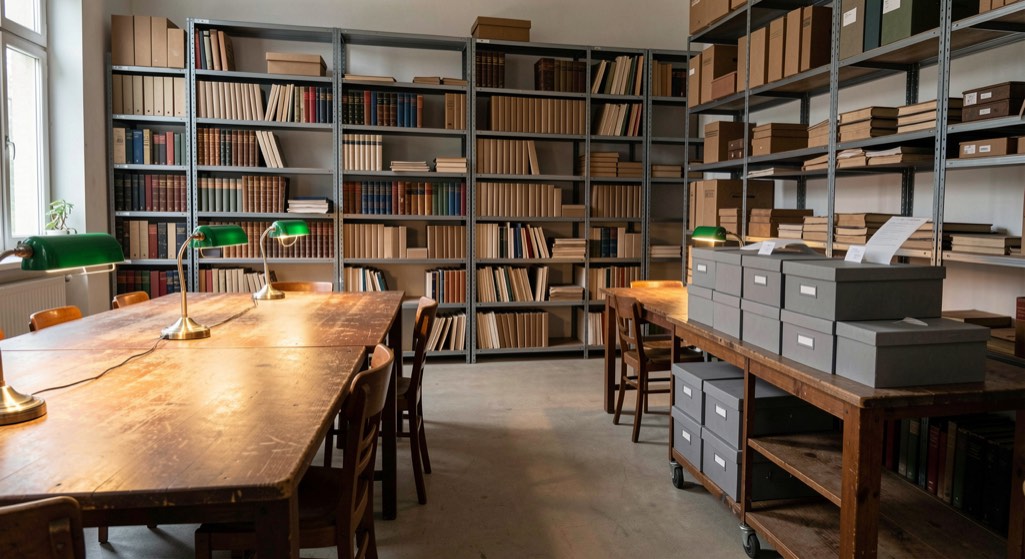
An office that answers to the University System
The Georgia Archives describes itself in one line that carries a lot of weight: it "preserves the records that tell the story of Georgia and its people." It has done that work since 1918, and it sits inside the University System of Georgia rather than under a records-request office or a court. That placement matters when you are routing a document search: the Archives is the historical keeper, not the counter where you order a current certificate.
You will not file an open records request with the Archives to settle a question about this year’s payroll. For the offices that publish the state’s current paperwork, start with the guide to the offices that publish, then come back here for the historical layer underneath.
Six doors into the building
The homepage lists six entries, and each one answers a different kind of question. The Virtual Vault holds Georgia’s historic documents available online. Finding Aids point you to original records that exist only for onsite research. The Catalog, labeled GIL, covers books and other publications available onsite. The Directory locates cultural and historical institutions across the state. Vital Records explains how to access Georgia’s vital records. A Research page explains how researching at the Archives works.
The practical order is worth fixing in your head: search the Vault first, because it is the part you can reach from anywhere. If the Vault does not have what you need, the Finding Aids tell you whether an original record exists and can only be consulted in person. The GIL catalog covers the printed and published material, which is a separate universe from the manuscript records.
What sits in the Virtual Vault?
The Vault is the Archives’ digital collection, and the homepage describes it plainly as the place to "browse Georgia’s historic documents available online." It is the right first stop for family research, property history, or any question you can answer from a digitized image rather than a paper original.
The homepage does not itemize which record series are inside the Vault, so do not assume a specific document type is there before you look. Treat the Vault as the part of the building that never closes, and the Finding Aids as the map to everything that did not get digitized.
Original records and the Finding Aids that lead to them
Finding Aids exist because most of what the Archives holds has not been scanned. The homepage describes them as the way to "discover original records available for onsite research." An aid is a written description of a record group: what it contains, how it is arranged, and what you would ask for once you are at the building in Morrow, Georgia, where the Archives keeps its facility.
This is the step people skip, and it is the one that saves a trip. If the Finding Aid says the records you want exist only onsite, you know before you leave home that the Vault will not substitute for a visit. And when even the Finding Aids run out, the question moves to paper nobody was required to keep; this guide covers what ephemera preserves when the official record is silent separately.
Where do vital records fit in?
The Archives homepage carries a Vital Records section that explains "how to access Georgia’s vital records." Read that wording carefully: the Archives explains access, it does not present itself as the counter that issues every certificate. For the current ordering rules and the offices that actually produce birth and death records, this guide keeps a separate entry on where Georgia birth and death certificates come from, because that is a records-request question, not an archives question.
The distinction shows up across state government. One office explains, another office issues, and a third office archives the older material. The Archives sits at the end of that chain. Property-side restrictions sit in yet another file, the county’s recorded instruments, the subject of what a recorded covenant still does to a neighborhood.
Can you search the holdings without going to Morrow?
Yes, in two ways. The Virtual Vault puts digitized documents in front of you directly, and the GIL catalog lets you search the books and other publications available onsite before you arrive. The homepage draws the line itself: the Vault is for browsing online, while the Finding Aids lead to records you consult onsite.
So the test for any document is simple. If it is in the Vault, you are done. If it is in the catalog or a Finding Aid, you are planning a visit or asking the Archives a question about it. The homepage does not state how far back the Vault reaches or how large the digitized collection is, so the only way to know whether your record made the cut is to search. The same habit works backwards when a printed rule needs tracing to the paper that created it: following a rule back to the document that made it.
Lectures, genealogy days and other reasons to visit
The Archives runs public programming alongside its reading services. The homepage announces an "Archives & Genealogy Day" for Saturday, October 3, 2026, with hands-on genealogy research and presentations on family history resources. It also lists Lunch and Learn lectures held noon to 1:00 p.m., with recordings made available on the Archives’ YouTube channel after each event.
The posted lecture schedule runs from September through December 2026 and covers local history and genealogy topics. The homepage also notes closures for the Labor Day holiday on Saturday, September 5, and Monday, September 7. If you are planning an onsite research day around a lecture, check those dates against the facility schedule, because the page we read does not publish a full year of closing days.
Building your search before you write to anyone
Whether your question is a family line, a county’s early records, or the history of a state institution, the sequence is the same. Search the Virtual Vault for anything digitized. Search the GIL catalog for published material. Read the Finding Aids for original records. Use the Research page to learn the onsite rules before you travel to Morrow. If your question turns out to be about the state’s current documents rather than its historical ones, the request rules are a different subject: see how a Georgia open records request works for the offices that answer those. The routing habit works below state level too: how to find your city’s sanitation ordinances asks the same three questions of municipal paper.
Checked 5 September 2026. The Georgia Archives, an agency of the University System of Georgia, is the state’s historical records keeper: it preserves the documents that tell the story of Georgia and its people, collects them through a Virtual Vault, Finding Aids, a GIL catalog, a Vital Records section, and a statewide Directory, and hosts them at its facility in Morrow with public lectures and genealogy programming. The official page is linked in the footer of this article.
Four later entries lean on the archive’s method in different directions: the parish register read against the civil record, a church archive read from far away, a public figure read through his own papers and a discography kept as a ledger. An old film located through the Archives can still carry rights that outlast the physical reel, so public domain status has to be checked before any use in a cut. Works published in the United States before 1930 are generally in the public domain, while later material may still be protected, and donor agreements, restrictions, or separate music and performance rights can apply even when the film itself is free. Editors weighing public domain and old film will find the clearance question treated alongside formats and delivery, which is the same order of checking this desk applies to paper records.
Built from Georgia Archives: https://www.georgiaarchives.org/. Page read on 5 September 2026. Official pages change: check the source before you rely on a figure.