REG-01 · Public records
The parish register next to the civil record
Georgia’s vital records office files what the state requires; parishes file what the rite requires. The two registers overlap, contradict and outdate each other, and a careful search reads both.
Published 6 September 2026 · The Georgia Records Desk editorial team
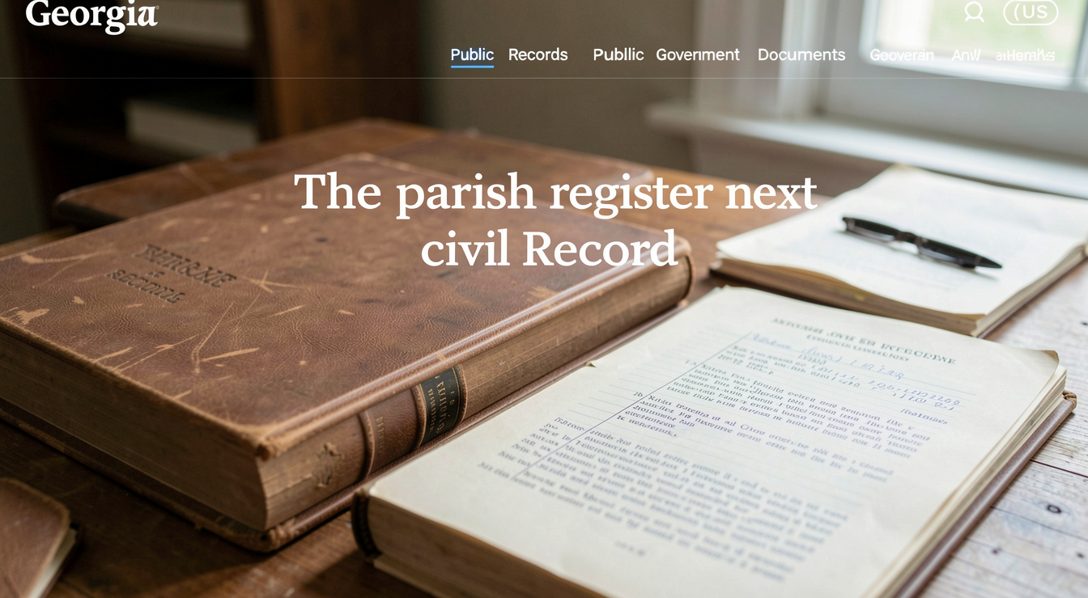
Two registers, two authorities
A civil birth or marriage record exists because the state requires it to be filed; a parish baptismal or marriage entry exists because the rite was performed. The entries can describe the same event on different dates and under different spellings, because each record answers to a different authority with its own calendar.
That calendar matters more than researchers expect. A parish keeping the Orthodox liturgical year records feasts and fasts, not fiscal quarters, and a marriage entry dated by the old calendar can sit weeks away from where a searcher first looks for it.
What does a parish entry contain?
A register entry typically names the person, the rite, the date, the officiant and the sponsors or witnesses. Godparents and witnesses are the genealogical yield: they map the family’s community in a way a state form never asks for. Burial entries add the cemetery and sometimes the cause the family gave.
The civil record, by contrast, is built for administration. It asks the questions the state needs answered, consistently, and skips the ones a community finds meaningful. Neither record substitutes for the other; they are parallel accounts of one life. The same split appears in estate paperwork, where a state statute and a private instrument both speak to the same property. A Georgia searcher reading two registers side by side will recognize the pattern: one office files what the rule requires, the other what the signer chose. For households outside Georgia, the questions of planning a will in Iowa follow a comparable structure, with each instrument handling the same property differently and the state rules published separately. Reading both before relying on either remains the habit this desk applies to every record set.
Which record came first?
In Georgia, statewide registration of births and deaths was not required until the twentieth century, and compliance lagged the law. For most of the nineteenth century the only written record of a birth or a marriage is the church’s or the county’s, not the state’s. This desk’s page on how vital records are filed marks where the state file begins; before that line, the parish register is the primary record.
Even after the state file exists, the church book keeps recording on its own terms, so the two series run side by side rather than one replacing the other.
Where are the registers kept?
A living parish keeps its own books. Where a congregation has closed or moved, the registers pass to a diocesan archive, a denominational collection or a local repository; Georgia Archives holds church records among its private collections for exactly this reason. The finding aid says which congregations’ books survived and where they came from.
Access rules are the parish’s own. A church register is not a public record in the legal sense; it is produced by courtesy and policy, not by an open records request.
How do you cite a record you were shown, not handed?
Parish registers are usually consulted on site or by correspondence, so the citation has to carry what a photocopy would have: the congregation, the volume, the page or entry number, and the date the register was read. A note that names its book can be checked; a note that says only “church records” cannot.
That is the same citation discipline this guide applies to county filings: name the book and page, as in reading a recorded covenant, so the next reader can reopen the exact entry.
Reading the two records against each other
The productive disagreements are the point. A baptismal entry can fix a birth year a census only approximates; a church marriage record can name a bride’s family where the civil license names only the couple. Read together, the registers corroborate; read alone, each leaves its own blind spots. The parish register and the civil record answer different questions, and neither settles the other. A rite recorded by a congregation and a birth filed with the state can disagree on a date, a spelling or a name, and each may reach back further than the other. Reading both is the ordinary work of a careful search. For the state side of that pair, the guide to records held at Morrow explains what the Georgia Archives collects since 1918, its Tuesday to Saturday hours, and the Virtual Vault, Finding Aids and GIL catalog that let a researcher look before traveling.
What georgiaarchives.org is
Georgia Archives preserves both sides of the divide described here: the state’s official record series and private collections that include surviving church registers. Its finding aids distinguish the two, which is the same distinction this page draws between what the state requires and what a community chose to write down.
Built from Georgia Archives: https://www.georgiaarchives.org/. Page read on 5 September 2026. Official pages change: check the source before you rely on a figure.